What the alternative looks like

Taxonomy upgrade extras: 

Tom Friedman's column yesterday was filed from Costa Rica, perhaps the globe's best example of how to prosper without exploiting native resources.

You're no doubt familiar with Costa Rica's many wonders, both natural and governmental. In a country roughly the size of West Virginia, it has rainforest, an active volcano, and both Caribbean and Pacific shores. It has decades of stable, democratic leadership, a literacy rate above 90 percent, and protects more than a quarter of its land for conservation.


What's the alternative?

Taxonomy upgrade extras: 

A week ago Friday, David Frum was among the guests on Bill Maher's HBO show, and one of the topics they skirmished on was energy. Frum talked about how expensive wind and solar are, which he said precludes moving toward them.

Maher's response was right on: So what's the alternative? Business is great and we all die? Unfortunately, the conversation went elsewhere, and Frum never responded, but that's an answer I'd really like to hear from the other side.


Keeping carbon down on the farm

Under the influence of Michael Pollan and others, I've written previously about how we've lost the connection between the food we eat and the world that produces it.

I don't know which should strike you as more absurd, that such a disconnect could occur, or that I could be the one mentioning it, again — I'm suburban all the way, a middling house-plant grower at best, and until recently, didn't even understand what other people meant by having a connection to the land.

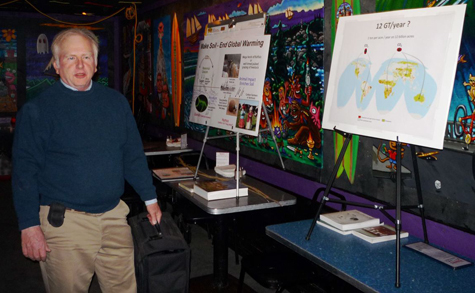
Jim Laurie, speaking on holistic management to an MCAN advisory committee gathering at Redbone's in Somerville, Mass.

And yet, here I am again, brought along this time by Jim Laurie, whom I heard speak Tuesday night at Redbones BBQ in Somerville, which I take pain to mention because they've been strong community supporters as long as they've been around. On Tuesday, they hosted the Mass. Climate Action Network, serving grass-fed beef donated by Chestnut Farms of Hardwick.


Climate Action Network news

Yesterday was my first opportunity to take part in the Mass. Climate Action Network as a member of its steering committee; there hadn't been any events since I volunteered to take part as Sustainable Arlington's representative a couple of months ago.

I'm not sure how I'll end up, but I think it's worth two posts, one on the presentation by Jim Laurie (see here), and one on the reports of activities by the town and regional climate-action groups. I'll do the latter first, to fulfill my liaison role with SA. (Info in the bulleted items is from group representatives; I'll post with MCAN and make corrections if necessary.)


Your mileage may vary; ours has

Taxonomy upgrade extras: 

My life with cars has been driven by a combination of bonehead purchases, lazy stewardship, and just plain bad luck. I've tried to improve with age, but I still feel snake-bitten. (The next-to-last car I bought was a VW Passat, based on the strong recommendation of Consumer Reports, but the car was an unreliable, high-cost, high-maintenance disappointment.)

Which brings me to our Prius, which we purchased about 22 months ago. I'm writing from our dealership, where I've come to try to learn why its mileage performance has substantially declined. I've just had my consult, and the news is not good. That is, there is no news, no mechanical flaw.


They'll probably just ruin it anyway

Taxonomy upgrade extras: 


The Daily Show With Jon Stewart M - Th 11p / 10c
The Ever Spending Story
comedycentral.com
Daily Show Full Episodes Economic Crisis Political Humor


One of this week's "Daily Show" outrage clip packages referenced duplicity in Congress, quoting solons (about 5 minutes in) complaining on how unfair some rule is and then showing how they defended the same rule years before, when their party ruled.

I didn't see it until after I read the summary of the Waxman/Markey climate bill introduced on Tuesday, but I think it helps explain, at least in a spiritual sense, why I haven't been able to muster much enthusiasm for what appears to be a very good starting point.

The bill has four sections, focusing on clean energy, energy efficiency, global climate change, and the transition away from current practices, and I like what it tries to accomplish, despite the sham funds for coal-related carbon capture and sequestration, which is just pouring money down a dry hole, as far as I'm concerned.

I know it's about pluralism, and understand that that money is going to buy the support of coal-state representatives. At least the nuclear lobby is less powerful, and less geo-centric, so they didn't need to pander to them, too; the bill doesn't even mention the word.

So why don't I love it? I think it's bullshit fatigue. 


See the Genzyme Building on Earth Day

The state affiliate of the U.S. Green Building Council will celebrate Earth Day from 6-9 p.m. April 16 at the celebrated headquarters of Genzyme, 500 Kendall St. Cambridge.

The event, which has no admission charge, is expected to draw architects, engineers, developers, government leaders, and others. After a cocktail reception is under way, the group will announce the recipient of the 2009 Innovation in Green Design Award.


Oct. 24

Taxonomy upgrade extras: 

I suspect this isn't the last time you'll hear Oct. 24 in a conversation about global climate change. it has been designated by a worldwide consortium of activists who want to send a message to the politicians who'll gather six weeks later in Copenhagen for the final round of talks to replace the Kyoto accords as the world's declared intentions to address global climate change.


Forging the philosophical and the practical

Taxonomy upgrade extras: 

It is emblematic of a larger condition that I've not reported before now on one of the most thought-provoking and valuable presentations from Building Energy '09, the annual conference of the Northeast Sustainable Energy Association held earlier this month in Boston — the keynote by Marc Rosenbaum.

Rosenbaum's comments were literate and far-reaching, on one of this century's most vital issues — how do we maintain life as we know it as traditional fuels decline and the climate changes?

But I chose instead to focus first on the contentious LEED public forum of the night, and the release of recommendations by the state's Zero Net Energy Task Force just before he spoke. There's some argument to be made for the latter — actual news — but I judged both to be shinier that Rosenbaum's topic, deep-energy retrofitting.

I have my reasons, but still, you could say my actions reflect the general outlook: people are more attracted to the glitz and gadgets around energy issues than they are to the real best solutions — conservation and efficiency. I'm totally sold on them, without reservation, and still, I'm getting to that portion of the conference three weeks later. 


Pages

Subscribe to Michael Prager RSS